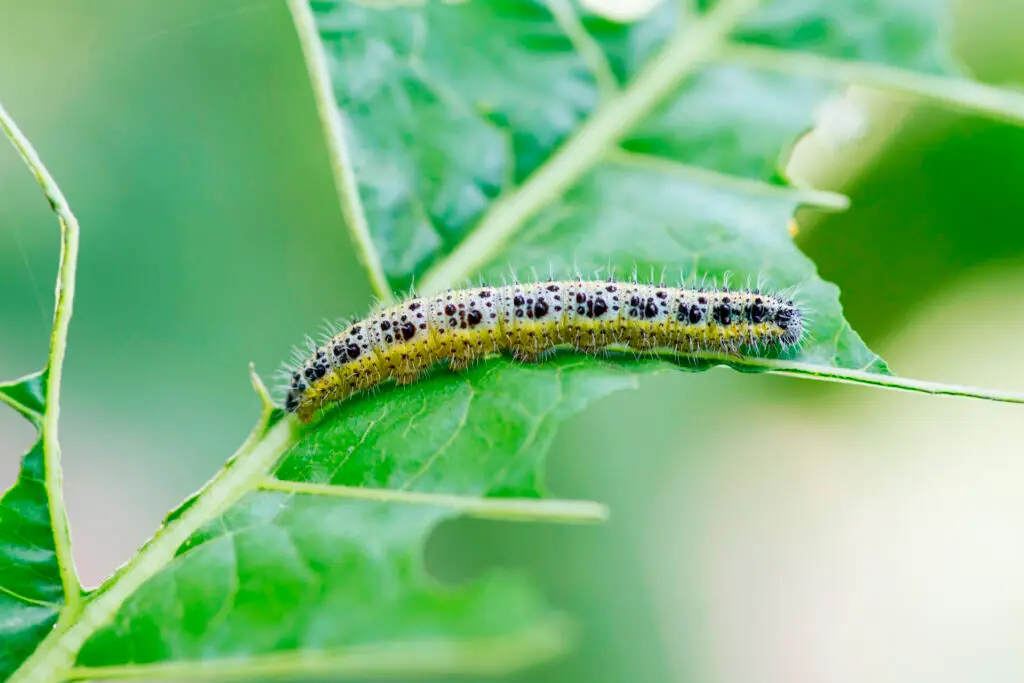
Cabbage worms are common garden pests that plague cauliflower, kale, cabbage, broccoli, and other cabbage family members. They are smooth green larvae with subtle, light yellow stripes.
Cabbage worms transform into white or light-yellow cabbage moths with tiny black specks. Moths lay small, oval, light-colored eggs on the tops, undersides, and crevices of leaves of cabbage family plants.
Then they transform into caterpillars which feed heavily on plant leaves, creating holes within the leaves, sometimes defoliating leaves and leaving only leaf veins behind. Seedlings and new head formations are most susceptible to crop damage and subsequent decreases in yields.
Follow our guide and discover how to prevent and how to get rid of cabbage worms so that you can protect your treasured crops.
How to Prevent Cabbage Worms
The best defense against pests is the cultivation of strong, healthy, and vigorous plants. Appropriate growing conditions like sunlight, temperature, water, nutrients, and plant protection will keep plants thriving, so they won’t succumb to troublesome pests like cabbage worms.
- Amend garden soil with well-decomposed composed and plenty of organic matter and keep soil microbial life well-fed and healthy.
- Use row covers to prevent cabbage moths from laying their eggs on leaves.
- Strategically interplant with plants that draw in predatory insects that feed on plants.
- Create a diversity of plants in your garden that will replicate the natural flora and fauna. By planting diverse varieties, pests may be more noticeable on certain leaf hues and can be picked off manually once spotted.
Companion Planting to Prevent Cabbage Worms
Using companion planting strategies can keep cabbage moths away from prized crops. Try interplanting with some of these stellar companion plant selections.
- Celery – The scent of celery plants deters the cabbage moth.
- Thyme – Masks the scent of those plants susceptible to cabbage worms and moths.
- Mustard – Mustard makes an exceptional trap crop. Cabbage moths are drawn to mustard plants, which may keep cabbage moths away from your precious plants.
- Borage – Repels cabbage moths and encourages beneficial insects.
- Chamomile- Repels cabbage moths and masks the scent of cabbage family plants.
How to Get Rid of Cabbage Worms
Looking for how to get rid of cabbage worms? There are several organic methods to help rid your plants of cabbage worms at all phases of development.
While controlling garden pests is essential, you never want to eliminate an insect population or use pesticides because that can negatively impact the ecosystem’s natural balance. Organic pest management strategies can go a long way to ensuring that your plants thrive and the circle of life is kept intact for all garden inhabitants.
Once you identify that you have a cabbage worm problem, here are some great strategies to decrease the damage they can cause by controlling cabbageworm populations.
- Pick eggs and caterpillars off your plants manually as you inspect plants. Routinely inspect your plants for signs of eggs and caterpillars, paying extra attention to leaf folds and leaf undersides.
- Place yellow sticky traps in the garden to capture adult moths before they lay their eggs. Keep in mind that beneficial insects may get trapped as well.
- Apply neem oil spray to cabbage family plants to smother soft-bodied insects. Neem oil is a natural ingredient extracted from the neem tree that has insecticidal and fungicidal properties. Apply it to leaves and stems to control cabbage worms if other methods have not been effective, as neem oil can negatively impact beneficial insect populations as well as garden pests.
- If a heavy infestation of cabbage worms has occurred, apply BT every 1 or 2 weeks. Before applying, look for beneficial insects that may be adversely impacted by its application.
- Shake cayenne pepper on and around plants to deter cabbage moths from settling on plants and making leaves unpalatable to cabbage worms.
- Spray cabbage family plant leaves with water and sprinkle cornmeal on plant leaves.
Safe Cabbage Worm Control
Plants at varying stages of growth can react in different ways to homemade or organic pest deterrents. The best approach to managing pests is to build up a healthy ecosystem in your garden so you will not need to use sprays. And yet, even in the healthiest gardens, some outside assistance may be needed.
To protect your plants and the good bugs:
- Test your mixture on a small area of the plant to see how the plant reacts.
- Spray plants in the early evening, so the sun does not intensify sprays and burn plants.
- Look out for beneficial insects before spraying. Oils, soaps, and other natural remedies can smother any soft body insects on contact.
Say goodbye to cabbage worms and hello to healthy plants with these expert tips! Find Kellogg Garden Products at a store near you today!