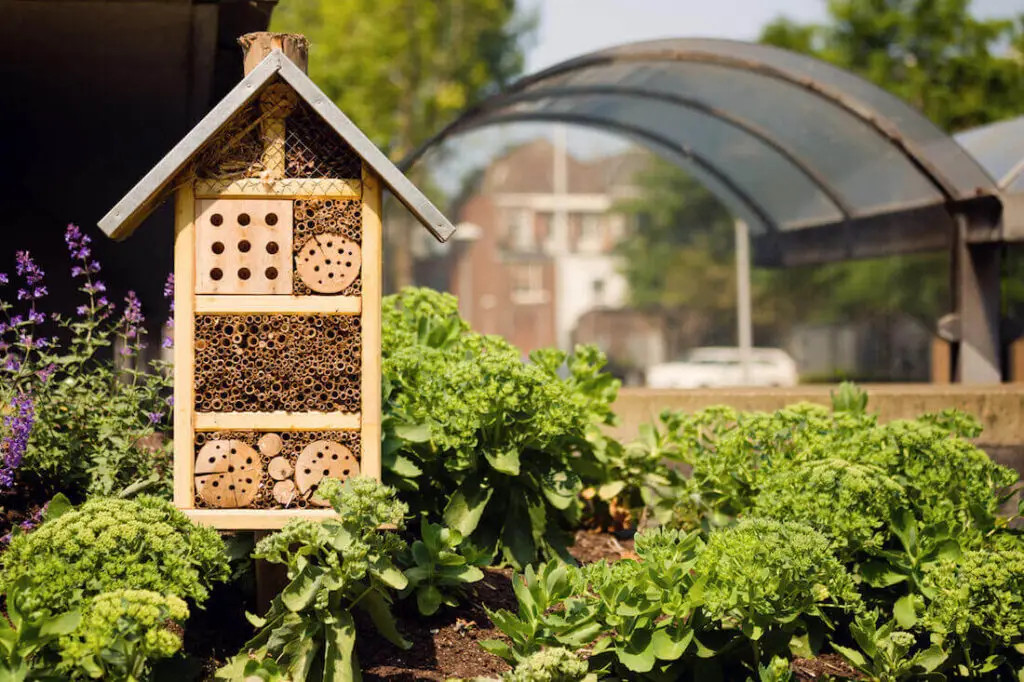
You’ve seen these bee houses everywhere — from big box stores, department stores, garden centers, and even membership stores. They’re cute, with their little house frames and the hollow reeds or bamboo in them. You can just picture bees happily living in there, and you feeling good that you’re doing your part to save the bees. Right? Well, as it turns out, maybe not.First, we want to commend you for wanting to get involved and making your garden hospitable to pollinators. It’s truly an important step when you realize that you can make a difference in your landscape.
Second, let’s focus that enthusiasm on activities and products that are, in fact, beneficial — and because it’s sometimes difficult to know what’s beneficial and what’s not, we’re here to help.
Should You Buy a Mason Bee House?
Bee houses, in theory, are valuable resources for mason bees — if you buy the right ones. The problem is that many (if not most) of the inexpensive, mass-produced houses are manufactured for their cuteness quotient rather than their functionality.
The best case scenario, then, is that the house you want to buy will simply not do the job, but the worst case scenario is that it could actually harm the bees that you so want to protect.
So, what do you look for? Here’s a quick rundown of mason bee house elements:
What do I Need in my Mason Bee House?
- Removable parts. Mason bee houses need to be thoroughly cleaned every year — a task that is impossible with parts that are glued in place.
- Deep blocks, tubes, and reeds. For bees that nest in holes that are a ¼” or wider, the tube or reed needs to be about 6” long. Most commercial bee houses are quite shallow, making it impossible for bees to have enough room to lay their fertilized eggs.
- An overhanging roof that is well-made. This might sound obvious, but a functional bee house needs a roof overhang to keep water from entering the nest opening.
- Breathable materials. Moisture is a part of life, but moisture that is stuck inside a bee house could mean death for the bees. Look for houses with tubes and reeds that are paper or cardboard, or which have holes drilled into the wooden tubes. Plastic, metal, or bamboo will not work.
- Houses that attach with screws. Turn the house over and inspect how it’s intended to attach to your tree or structure. Is there a little picture hanger, a string, or place for a nail? Skip it. That house will blow around in the wind and possibly fall off. Good bee houses attach securely with screws.
- Nesting tubes or reeds that are closed on the back. Cute houses with open backs? Don’t buy them. Those open backs give parasites and other pests an open invitation to crash the party. You want a bee house with a backing on it.
- Houses that come with detailed instructions. If a manufacturer is legitimately concerned with the bees rather than simply making adorable garden art, then it will provide detailed instructions on how to use the bee house, how to clean it, and where to place it. No directions? No purchase.
Where Can I Buy a Good Mason Bee House?
Look for bee houses from places like seed companies, wildlife sites, dedicated bee companies/businesses, reputable garden centers, and gift shops at botanical gardens/arboretums. These are all sources that are educated about what bees actually need to live and thrive. Avoid mass-produced products with shoddy craftsmanship and subpar materials — the low price will be one of your first indicators that it’s not a functional and high-quality house.
Bee houses are cute — but there is absolutely no need to sacrifice appearance for functionality, or vice versa. Do your homework to make sure you are giving the bees a safe and healthy environment to live and raise their offspring.
Tip: When in doubt, build. If you can’t be sure what you are buying has all the necessary features to give your local mason bees a good home, you can build it. Use the list we created of what to look for to build your own mason bee home. Kellogg Garden OrganicsAll Natural Garden Soil
**Product not available in AZ, CA, HI, NV, UT. For a comparable product in these states click here.