
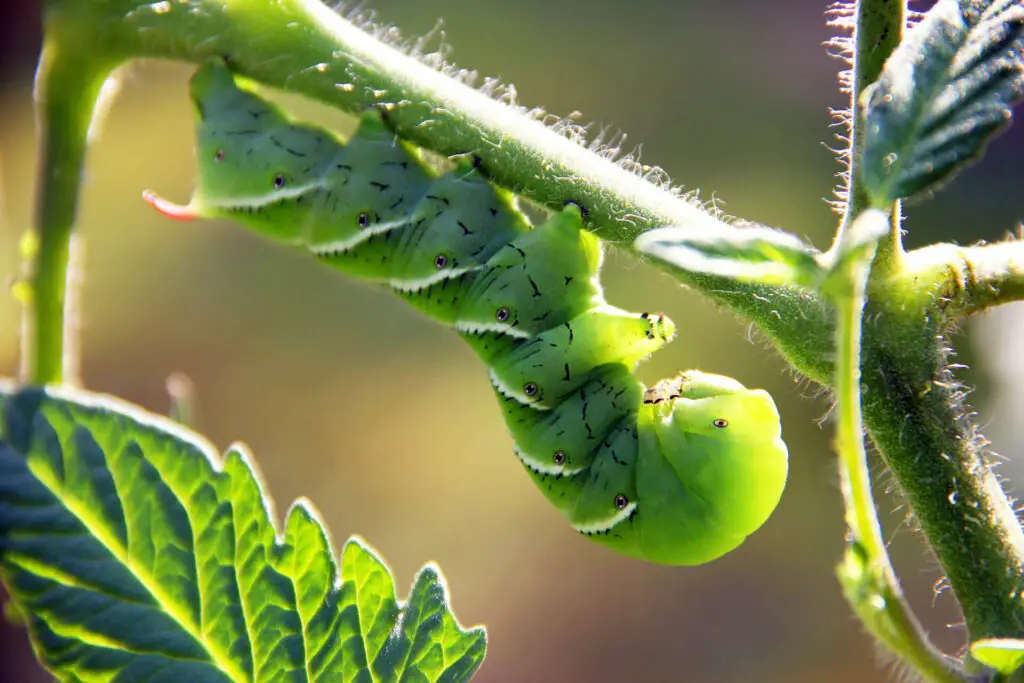
The tomato hornworm is a big green caterpillar with white stripes and a black horn-like protrusion on its rear. Because they can grow up to 4″ long, you would think they would be easy to spot. Their green color provides the ultimate camouflage, however, and allows them to be close to invisible against the green of a tomato plant. Gardeners often discover hornworms only after a plant has been stripped of its foliage.
Tomatoes are not the only plant these caterpillars eat. They also dine on eggplant, peppers, moonflowers, and potatoes.
Remove Tomato Hornworms by Handpicking
Tomato hornworms are large so they are not hard to find and easy to control by handpicking. Daily observation is key to keeping hornworms in check. Normally found in small numbers, even one or two can strip a plant in just a day. Simply squash or drop them in soapy water. Rototill your garden beds in late fall, after the harvest, to kill overwintering caterpillars and pupae.Marigold Pest Repellent
The essential oils in the marigold act as a repellent to many insects, including the moth that lays the tomato hornworm. Plant marigolds around crops that attract tomato hornworms, as well as throughout the garden.
Beneficial insects are the most effective means of keeping tomato hornworms in check. Hornworm caterpillars are a favorite host for parasitic wasps. The wasp lays it eggs in the caterpillar. When the larvae hatch, they consume their host from the inside out, leaving behind only mummified remains. Attract these beneficial insects by planting a wide variety of herbs and open-pollinated flowers.
Try plants with an umbrella or flat shaped clusters of tiny flowers like Queen Anne’s lace or yarrow. Angelica, coriander, cosmos, and tansy also support parasitic wasp populations.
Plant Extra Tomatoes
Consider planting more than you need so that the loss of a few plants is not an issue. Allow some of these creatures to survive and pupate. The tomato hornworm emerges from its cocoon a five-spotted hawk moth, also referred to as a ‘hummingbird moth’. This large-bodied, pale brown or gray moth resembles a hummingbird in its body shape and behavior. The five-spotted hawkmoth becomes active after dusk, appearing like a ghostly hummingbird as it hovers around moonflowers and ginger lilies, drinking nectar.