Succulents are enjoying a much-deserved time in the spotlight in recent years. These easy-care plants offer incredible forms, an unbelievable range of colors, and a wide range of sizes (and therefore, uses). Some of our favorite succulents for both gardeners and garden designers are the ones that hang, drape, or cascade — this growth habit allows them to be used in so many ways. From container plantings, hanging baskets, vertical gardens, and tiered gardens, hanging succulents offer low-maintenance softness with unmatched drama. Here are a few favorites.
Top 3 Hanging Succulents:
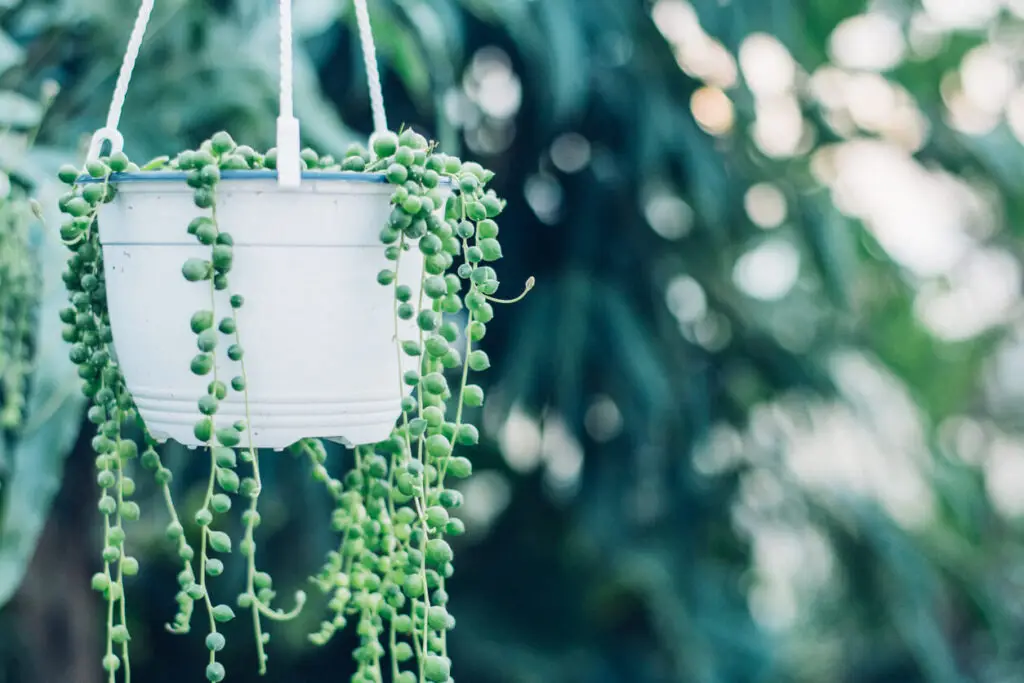
1. String of pearls: (Senecio Rowleyanus) This hanging succulent is one of the most popular around, because of its bright green pea-shaped leaves on 3’ long tails. It makes you want to reach out and touch it, but don’t — if it’s jostled too much, those little peas/pearl will fall right off. It’s happened to me so many times that, for a while, I was convinced this plant was fussy. It’s actually not — leave it alone, and you’ll be good.
2. Burro’s tail: (Sedum Morganianum) Also answering to the common names of Donkey’s Tail or Horse’s Tail, Burro’s Tail is a low-maintenance, slow-growing succulent with tails that grow up to 4 foot in length. The light green leaves overlap, forming a kind of braided “tail” that, over time, can get quite heavy, so be sure to plant it in a sturdy pot or hanging basket that won’t fall over. The plump leaves of Burro’s Tail can fall off easily when it’s being planted or moved — take extra care to perform these tasks gently.3. Fishhooks Senecio: (Senecio Radicans) This trailing beauty is arguably one of the easiest of the hanging succulents to grow, in my experience. With gray-green fishhook-shaped leaves that grow up (or down!) to 4’ long, it adds drama to any arid container planting. One of the characteristics I love best about this plant, however, is its hardiness — it can take anywhere from 25-100+ degrees, provided it’s not in full sun.
Note: There is another hanging succulent, String of Bananas, that goes by the same botanical name that Fishhooks does — the foliage is plumper, though, resembling a banana shape.
How to Care for Hanging Succulents
Most succulents have similar growing conditions, but when in doubt, do a little research to find more specific care directions.
- Bright, indirect light is best. Morning sun with afternoon shade gives your hanging succulent adequate light without burning, but if you live in an area with intense sun, go for all-day dappled shade.
- Less is more on the watering front. Aim to give them a thorough watering every 10 days to 2 weeks (again—check for plant-specific recommendations), and less in the winter or if you have them inside your home as a houseplant.
- Fertilizing is not necessary. Unless, of course, you have reason to suspect your succulent needs it. Otherwise, put some worm castings on the soil surface once a year, and you’re good to go.
- Choose the right soil. No potting soil here, please! These succulents need well-draining soil that doesn’t hold moisture in, so look for and use those mixes developed for cacti and succulents.